Digital where it moves learning forward.
The foundation of every evulpo offering, at school, at home and at work.
The pedagogical concept behind evulpo was developed with partners from the University of Zurich and EPFL.



Understand content. Deepen it. Apply.
Three principles from learning science shape how a learning unit is built.
Bloom’s taxonomy
Understanding, step by step
Spiral principle
Coming back to what was learned
Scaffolding
Becoming independent, with support


«A square has four lines of symmetry, a rectangle only two. Why?»
«What is the line called that a figure is mirrored along?»
«Explain what line-symmetric means.»
«Draw all lines of symmetry in the letters A, H and E.»
«A square has four lines of symmetry, a rectangle only two. Why?»
Remember
Understand
Apply
Analyse
Learning goes deeper step by step: if you know a term, you can explain it. If you have understood it, you can apply it and finally analyse how things connect.
Every learning path states its learning goals and the Lehrplan 21 competences it covers.
Bloom’s taxonomy
Understanding, step by step
Spiral principle
Coming back to what was learned
Scaffolding
Becoming independent, with support
«A square has four lines of symmetry, a rectangle only two. Why?»
«What is the line called that a figure is mirrored along?»
«Explain what line-symmetric means.»
«Draw all lines of symmetry in the letters A, H and E.»
«A square has four lines of symmetry, a rectangle only two. Why?»
Remember
Understand
Apply
Analyse
Learning goes deeper step by step: if you know a term, you can explain it. If you have understood it, you can apply it and finally analyse how things connect.
Every learning path states its learning goals and the Lehrplan 21 competences it covers.
A clear path through a topic.
The learning goal sets the structure. Explanations, examples, exercises and feedback work together.
1
Learning goal
Know what matters.
Every learning path starts with clear learning goals, phrased as «You can …» statements and linked to Lehrplan 21 competences.

Each learning goal names its competences, for example MA.2.A.1.g
The learning path follows the chapter in the textbook, for example LMVZ Mathematik 1
2
Explanation
Understand the concept.
The theory explains the concept clearly, with text, illustrations and, where it helps, short videos.
Digital explanations can be repeated at any time
Teachers can project the theory in class
3
Worked example
Follow the solution.
A worked example shows the solution step by step, before learners try it themselves.
4
Exercise
Make your own attempt.
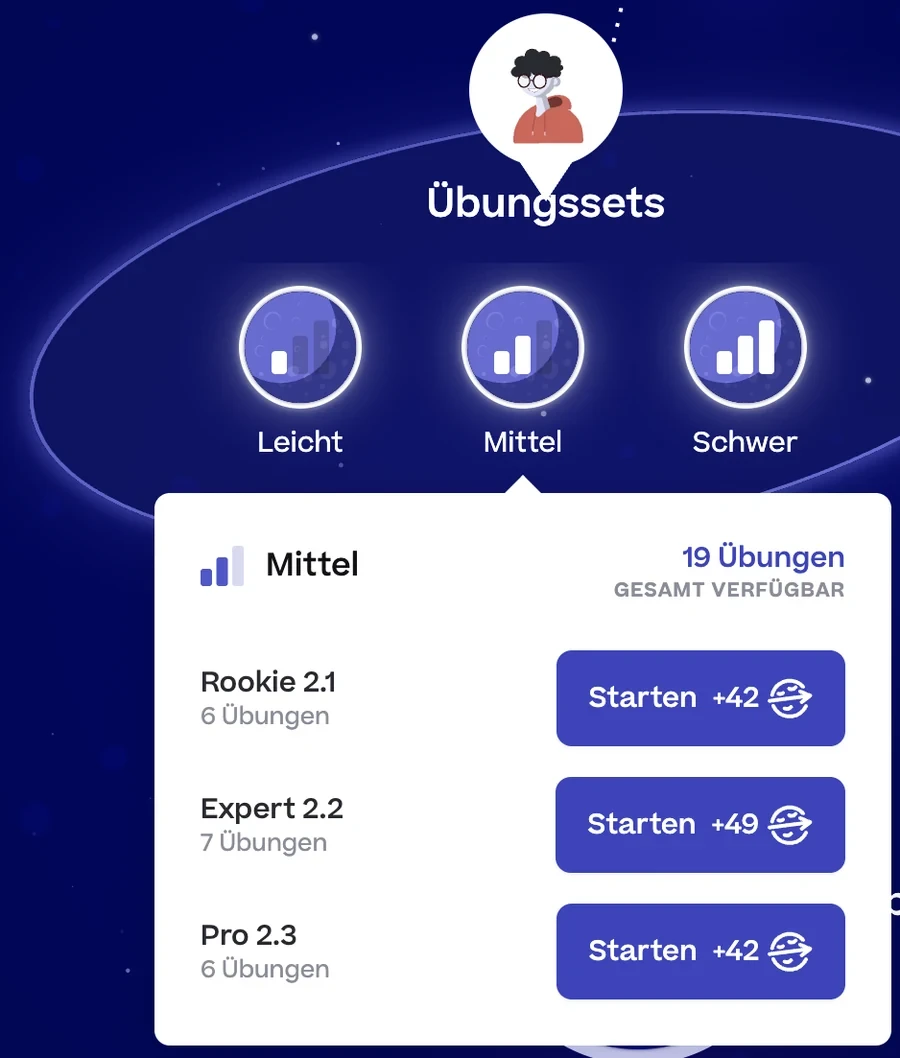
Exercise sets in easy, medium and hard. Each level has several sets, so everyone practises at their level and moves up.
In the learning path on line symmetry: 14 easy, 19 medium and 14 hard exercises
Teachers assign a level to the class or to individual students
Many exercises are marked automatically
5
Feedback
Check answers and understand mistakes.
Every answer gets instant feedback. Open answers also get detailed, automatic feedback that shows what is right and what is missing.
The «Solution» button shows how to solve it
Teachers see which questions or topics the class finds difficult
6
Application
Transfer knowledge to a task.
What has been learned is transferred to new situations, for example to shapes and forms from everyday life.
7
Self-reflection
Assess your own skills.
At the end, reflection questions help learners assess their own learning: what can I already do, where do I keep practising?
LMVZ Mathematik 1
1a Line symmetry
1. Sek
Learning goals

You can explain what line-symmetric means.
You can check with a mirror or by folding whether a figure is line-symmetric.
You can draw lines of symmetry in figures and letters.
You can recognise line-symmetric figures around you.
Competences: MA.2.A.1.g · MA.2.B.1.h · MA.2.C.2.g
1
Learning goal
Know what matters.
Every learning path starts with clear learning goals, phrased as «You can …» statements and linked to Lehrplan 21 competences.
Each learning goal names its competences, for example MA.2.A.1.g
The learning path follows the chapter in the textbook, for example LMVZ Mathematik 1
LMVZ Mathematik 1
1a Line symmetry
1. Sek
Learning goals
You can explain what line-symmetric means.
You can check with a mirror or by folding whether a figure is line-symmetric.
You can draw lines of symmetry in figures and letters.
You can recognise line-symmetric figures around you.
Competences: MA.2.A.1.g · MA.2.B.1.h · MA.2.C.2.g
2
Explanation
Understand the concept.
The theory explains the concept clearly, with text, illustrations and, where it helps, short videos.
Digital explanations can be repeated at any time
Teachers can project the theory in class
3
Worked example
Follow the solution.
A worked example shows the solution step by step, before learners try it themselves.
Is this rectangle line-symmetric?
1
Fold the rectangle along the dashed line.
2
Both halves lie exactly on top of each other.
3
So the fold line is a line of symmetry.
4
Exercise
Make your own attempt.
Exercise sets in easy, medium and hard. Each level has several sets, so everyone practises at their level and moves up.
In the learning path on line symmetry: 14 easy, 19 medium and 14 hard exercises
Teachers assign a level to the class or to individual students
Many exercises are marked automatically
5
Feedback
Check answers and understand mistakes.
Every answer gets instant feedback. Open answers also get detailed, automatic feedback that shows what is right and what is missing.
The «Solution» button shows how to solve it
Teachers see which questions or topics the class finds difficult

6
Application
Transfer knowledge to a task.
What has been learned is transferred to new situations, for example to shapes and forms from everyday life.
Which of these shapes are line-symmetric?


Correct: the heart and the house.
7
Self-reflection
Assess your own skills.
At the end, reflection questions help learners assess their own learning: what can I already do, where do I keep practising?
How confident are you drawing lines of symmetry?
Not yet sure
Mostly
Confident
1
Learning goal
Know what matters.
Every learning path starts with clear learning goals, phrased as «You can …» statements and linked to Lehrplan 21 competences.
Each learning goal names its competences, for example MA.2.A.1.g
The learning path follows the chapter in the textbook, for example LMVZ Mathematik 1
LMVZ Mathematik 1
1a Line symmetry
1. Sek
Learning goals
You can explain what line-symmetric means.
You can check with a mirror or by folding whether a figure is line-symmetric.
You can draw lines of symmetry in figures and letters.
You can recognise line-symmetric figures around you.
Competences: MA.2.A.1.g · MA.2.B.1.h · MA.2.C.2.g
2
Explanation
Understand the concept.
The theory explains the concept clearly, with text, illustrations and, where it helps, short videos.
Digital explanations can be repeated at any time
Teachers can project the theory in class
3
Worked example
Follow the solution.
A worked example shows the solution step by step, before learners try it themselves.
Is this rectangle line-symmetric?
1
Fold the rectangle along the dashed line.
2
Both halves lie exactly on top of each other.
3
So the fold line is a line of symmetry.
4
Exercise
Make your own attempt.
Exercise sets in easy, medium and hard. Each level has several sets, so everyone practises at their level and moves up.
In the learning path on line symmetry: 14 easy, 19 medium and 14 hard exercises
Teachers assign a level to the class or to individual students
Many exercises are marked automatically
5
Feedback
Check answers and understand mistakes.
Every answer gets instant feedback. Open answers also get detailed, automatic feedback that shows what is right and what is missing.
The «Solution» button shows how to solve it
Teachers see which questions or topics the class finds difficult
6
Application
Transfer knowledge to a task.
What has been learned is transferred to new situations, for example to shapes and forms from everyday life.
Which of these shapes are line-symmetric?
Correct: the heart and the house.
7
Self-reflection
Assess your own skills.
At the end, reflection questions help learners assess their own learning: what can I already do, where do I keep practising?
How confident are you drawing lines of symmetry?
Not yet sure
Mostly
Confident

1
2
Technology helps. People guide.
Digital explanations can be repeated, feedback gives direction. Conversations and collaboration remain important: teachers, families and trainers guide the learning that follows.
1
The platform shows where the class stands. Completed exercise sets, average score and active students at a glance.
2
The teacher decides. «Zur Überprüfung?» (to review) shows who is worth a closer look. The teacher leads the conversation.
Technology helps. People guide.
Digital explanations can be repeated, feedback gives direction. Conversations and collaboration remain important: teachers, families and trainers guide the learning that follows.
1
2
1
The platform shows where the class stands. Completed exercise sets, average score and active students at a glance.
2
The teacher decides. «Zur Überprüfung?» (to review) shows who is worth a closer look. The teacher leads the conversation.
Carefully developed. Expertly reviewed.
Experts plan, develop and review our learning content. AI only supports – responsibility stays with people.



Clarify learning goals, prior knowledge and target group.
Combine explanations, examples, tasks and feedback.
Experts develop the content, supported by AI.
People check subject accuracy, language and didactics.
Feedback and reported errors are worked in.
1
Align
2
Design
3
Create
4
Review
5
Improve

Where would you like to support learning?
